AlphaZero for 2048
An AlphaZero agent that learns 2048 from self-play alone. A residual policy/value network scores boards and suggests moves; a chance-aware Monte Carlo Tree Search (MCTS) plans around the random tile spawns, on top of a 1-D board engine written for speed. After 20 iterations it reaches 2048 in about 28% of late self-play games, with no human evaluation features anywhere in move selection.
Problem
The record-holding 2048 agents lean on hand-tuned features: monotonicity, smoothness, empty cells. Change the rules and you retune them. I wanted an agent that is never told what a good board looks like. That means learning an evaluation over something like 10⁵² reachable boards, with a random 2 or 4 dropped in after every move.
Approach
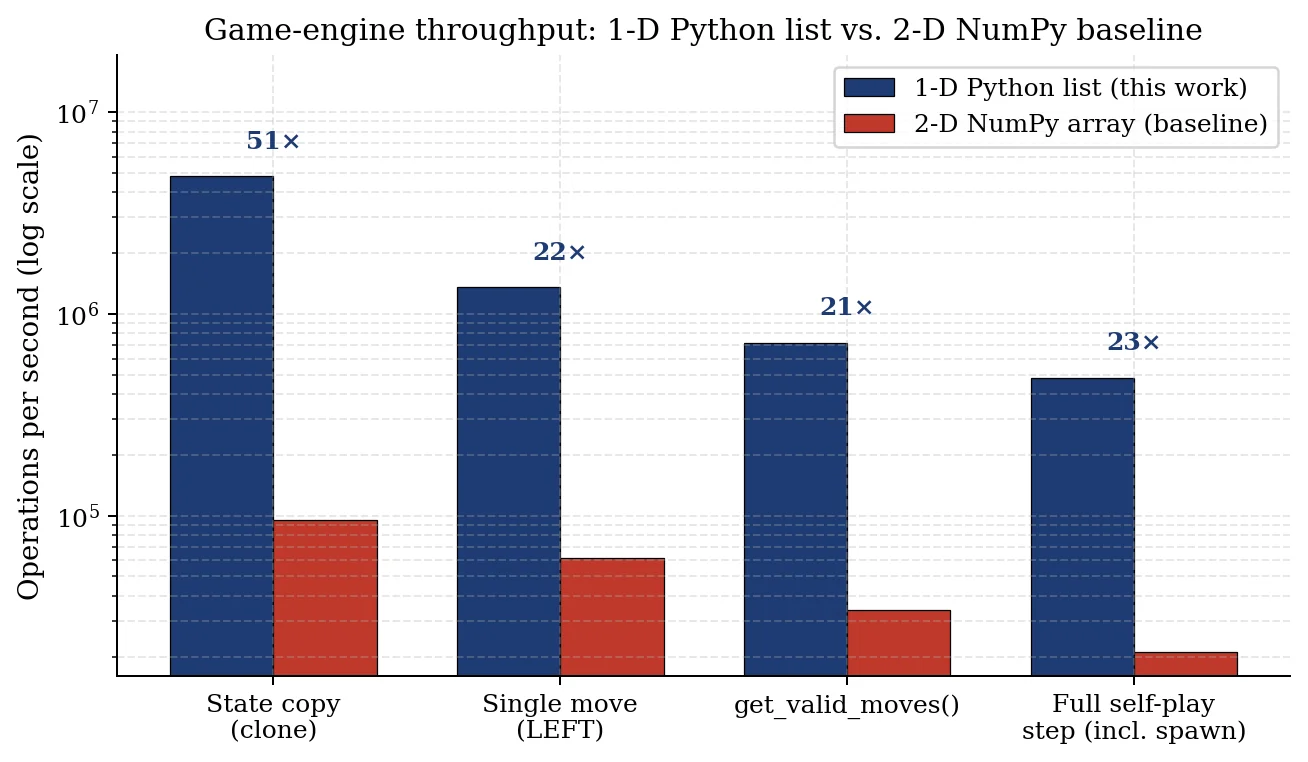
- The board is a 16-element Python list with a row-shift cache, not a 4×4 NumPy array. At that size NumPy's per-call overhead dominates: a clone → move → spawn → legal-moves cycle runs at ~480k/s on the list and ~21k/s on NumPy. Self-play is engine-bound, so that is training time saved directly.
- Tile powers are one-hot encoded into 16 channels and fed to ZeroNet: 8 residual blocks, 128 channels, about 2.5M parameters. MCTS stays on at inference because the network never fully matches its search-improved targets, and endgames need lookahead the policy alone does not have.
- Random spawns feed MCTS value estimates without expanding chance nodes. Batching leaf evaluation across concurrent games took GPU utilisation from a few percent to over 80%, the single biggest throughput win. Training used 8-fold D4 augmentation, mixed precision, a cosine learning rate from 10⁻³ to 10⁻⁵, and a 10⁵-transition replay buffer.
Results
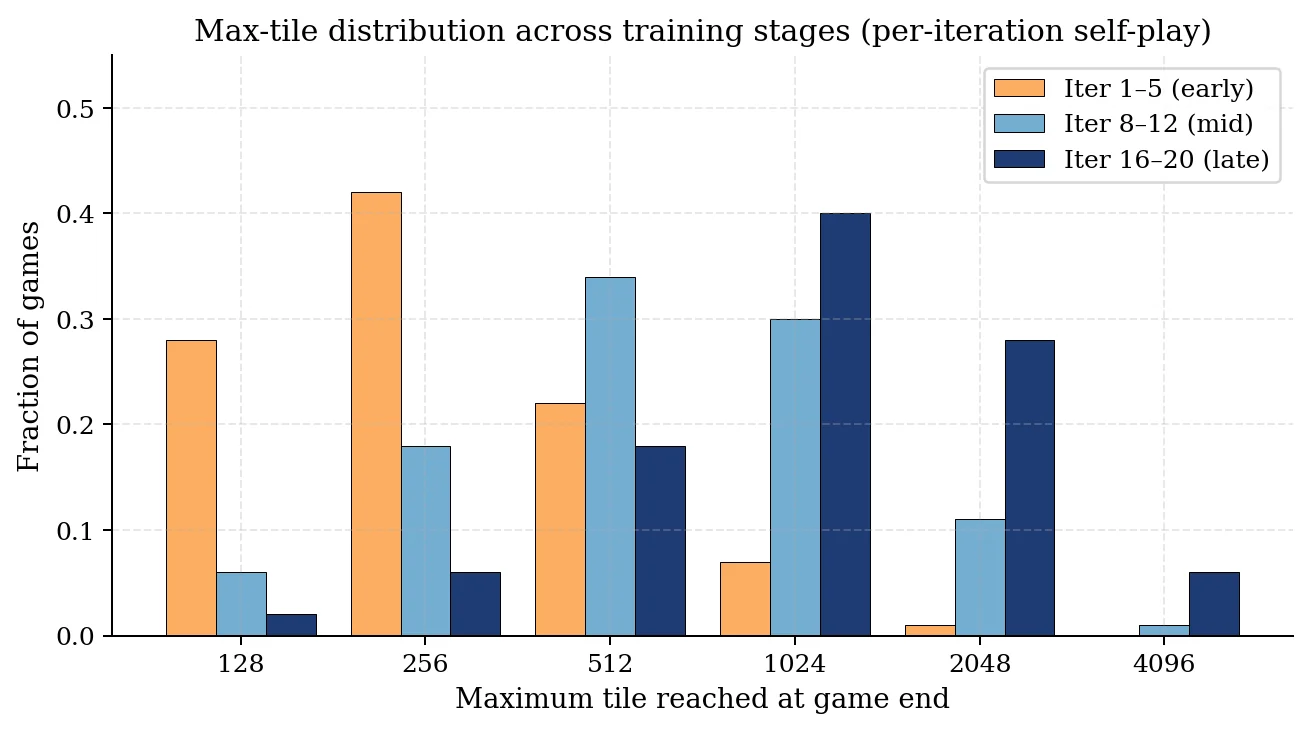
- After 20 self-play iterations, about 20 hours on one workstation with a single GPU/MPS device, late-stage self-play reaches 2048 in about 28% of games and 4096 in about 1 in 17. In the first five iterations it rarely cleared 512.
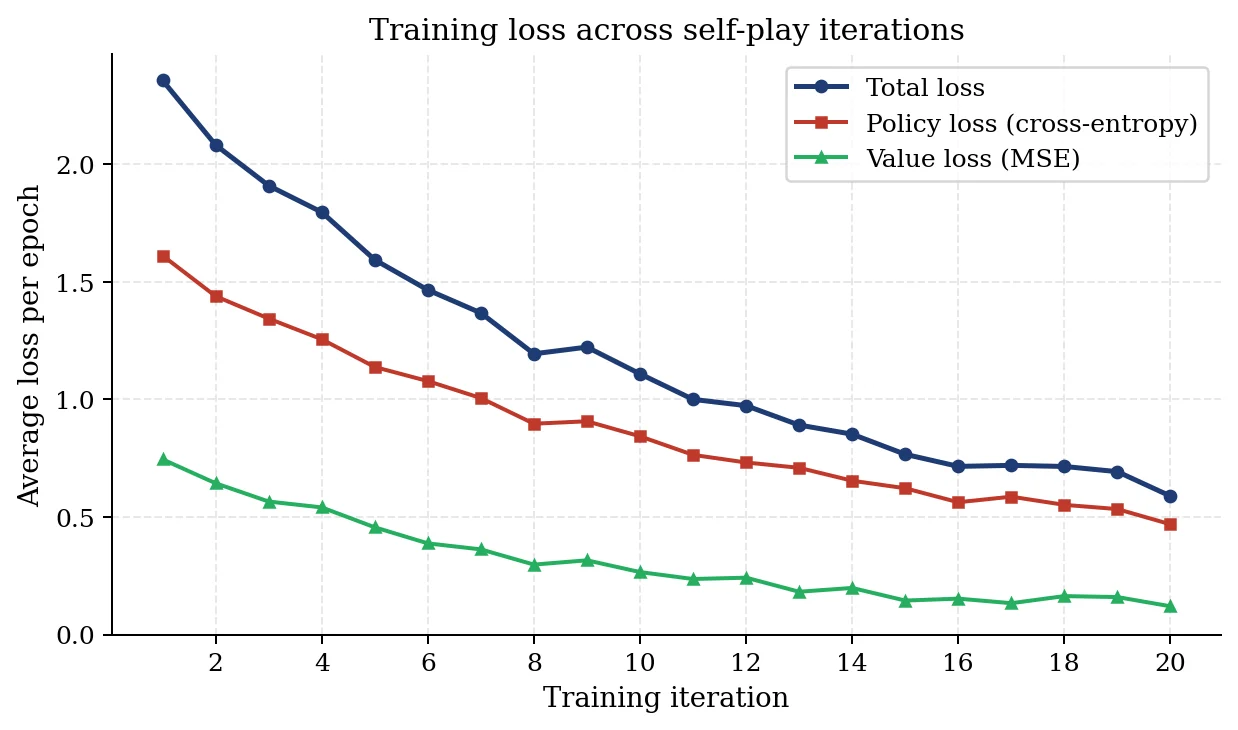
- Policy cross-entropy fell from ~ln 4 to ~0.5, value MSE from ~0.75 to under 0.15, with no collapse along the way. The 1-D engine is what made an overnight run possible instead of a long weekend.
Limits
- This is nowhere near the TD + Expectimax record (32,768 in over 30% of games). What it has instead is a policy taught by nothing but play.
Metrics
- late games reach 2048
- 28%
- engine vs NumPy
- 20–51×
- ZeroNet parameters
- ~2.5M
- one workstation, single GPU/MPS
- ~20 h
Architecture
- 1-D engine + row-shift cache
- ZeroNet (8×128 residual)
- Chance-aware MCTS
- Batched concurrent self-play
- Replay buffer + 8-fold D4
From the report
From chapter 6 of the report: loss over 20 iterations, engine throughput against NumPy, and the max-tile distribution moving right as training goes on.